
Bunion Surgery In New Orleans
New Orleans' Only Lapiplasty® Centurion Center Surgeon — Advanced Bunion Correction, Personalized to You




Dr. Edward Lang is one of New Orleans’ most experienced podiatrists, with over 30 years in practice and more than 7,700 bone surgeries performed. His experience also includes over 21,000 total procedures and more than 250,000 patient encounters—reflecting decades of comprehensive foot and ankle care.
Advanced Solutions To Bunion Pain
Bunions are a progressive structural deformity—not just a bump. Left untreated, they can worsen over time, leading to pain, joint damage, nerve damage, and additional deformities such as hammertoes.
At New Orleans Podiatry, we provide advanced surgical procedures for bunion correction, including Lapiplasty® 3D Bunion Correction and Minimally Invasive Surgery (MIS). Restoring the big toe joint to its normal position offers long-term pain relief and stability, helping you participate in the activities you love.
We offer advanced Lapiplasty® and minimally invasive bunion surgery (MIS), selecting the right approach based on your anatomy, joint stability, and long-term goals—not a one-size-fits-all approach.
Misalignment of the big toe joint, causing a bony bump (hallux valgus deformity)
Pain, swelling, redness, difficulty walking, and trouble wearing shoes
Lapiplasty®, Minimally Invasive Surgery, or conservative mitigation
Reduce pain, restore alignment, and improve long-term function
A bunion forms when the metatarsal bone in the foot shifts and the big toe joint angles toward the second toe. This pushes the joint outward, creating the visible bump often associated with bunion symptoms.
Bunions are not caused by a single factor—they develop from a combination of structural, genetic, and lifestyle contributors.


•A bony bump on the side of your foot at the base of the great toe
•Corns or other irritations caused by the overlap of the great and second toes
•Pain, redness, or swelling at the metatarsophalangeal joint
•Restricted or painful movement of the great toe
•Abnormal gait or changes in the way you walk
When the toes rub against the inside of shoes—especially pointy-toed or narrow-toe-box styles—symptoms worsen. Over time, a mild bony enlargement can progress into a severe deformity that causes ongoing pain and difficulty walking.
•Genetics and inherited foot structure
•Fallen arches or flat feet
•Prior foot injuries
•Neuromuscular problems (more common in complex or pediatric cases)
•Occupational stress on the feet, especially with unsupportive footwear
•Pronated feet (feet that roll inward when walking or running)
•Poorly fitting or restrictive footwear
•High heels
•Ligament laxity or joint instability
The Future of Bunion Correction Is Here
When conservative care no longer provides relief, Dr. Lang offers two advanced surgical approaches. Both are performed in an outpatient setting. The right choice depends on your specific anatomy and goals—Dr. Lang will walk you through both at your consultation.
Dr. Edward Lang is a Lapiplasty® Centurion Center surgeon—a designation awarded to surgeons who have completed over 100 Lapiplasty® procedures with demonstrated advanced training. He is the only surgeon in New Orleans to hold this designation.
Lapiplasty® 3D Bunion Correction addresses the root cause of the bunion by correcting the misalignment in three dimensions. Unlike traditional bunion surgery, which only shaves the bump, Lapiplasty® repositions the entire metatarsal bone and stabilizes the joint at its foundation—significantly reducing the risk of recurrence.
Best suited for: Patients with moderate to severe bunions, joint instability, or a history of bunion recurrence.
Minimally Invasive Surgery uses tiny, strategically placed incisions—typically just a few millimeters long—to reposition the big toe joint and improve alignment. Dr. Lang uses specialized instruments and high-definition imaging to precisely reshape and realign the first metatarsal and surrounding structures, preserving healthy tissue and minimizing recovery time.
Patients are typically able to bear weight in a protective surgical shoe the same day and return to regular shoes within 14–21 days.
Best suited for: Patients with mild to moderate bunions who prioritize a faster recovery and minimal scarring.
Lapiplasty® vs. Minimally Invasive Bunion Surgery
Not all bunions are the same—and choosing the right procedure is not about preference, it is about structure.
Bunions are driven by an underlying instability of the joint, not just a visible bump. In some cases, that instability must be fully corrected to prevent recurrence. In others, a less invasive approach can provide excellent results when the joint remains stable.
Dr. Lang determines the appropriate surgical approach based on your anatomy, joint stability, and long-term outcome—not simply the appearance of the deformity.
How We Select the Right Procedure
Both Lapiplasty® and minimally invasive bunion surgery are performed as outpatient procedures, but they serve different purposes.
Lapiplasty® corrects the bunion at its structural source — realigning the joint in three dimensions and stabilizing it with fixation. MIS uses small incisions to realign and reshape bone with less tissue disruption, and is best suited for cases where the joint remains stable and a full structural reconstruction is not required.
The decision is not based on size alone—it is based on stability, alignment, and the likelihood of long-term success.
Our Approach to Bunion Correction
In our practice, we prioritize lasting correction over temporary improvement.
Lapiplasty® is often recommended when there is measurable joint instability or risk of progression, offering a more stable and durable outcome. Minimally invasive techniques are reserved for select patients where a less invasive approach can achieve a predictable correction without compromising long-term results.
The comparison below outlines how these two approaches differ across the factors that matter most.
Lapiplasty® 3D Bunion Correction | Minimally Invasive Surgery (MIS) |
|---|---|
| Correction Type: 3D realignment of the entire metatarsal bone | Correction Type: Percutaneous reshaping and repositioning |
| Incision Size: Standard surgical incision | Incision Size: A few millimeters (minimal scarring) |
| Weight Bearing: Non-weight bearing for 2–4 weeks | Weight Bearing: Partial weight bearing same day |
| Return to Shoes: 4–6 weeks (tennis shoe) | Return to Shoes: 14–21 days |
| Return to Activity: ~3 months | Return to Activity: 4–6 weeks |
| Recurrence Risk: Lower — foundational joint stabilization | Recurrence Risk: Low — dependent on anatomy |
| Hardware: Titanium plates — often removed at 6–12 months | Hardware: Minimal hardware — often removed at 6–12 months |
| Dr. Lang's Designation: Lapiplasty® Centurion Center Surgeon | Dr. Lang's Designation: Advanced MIS Training |

Mild bunion: A small bony bump that causes occasional discomfort, typically manageable with conservative care.
Moderate bunion: More noticeable deformity with discomfort during activity and difficulty finding comfortable shoes. Often a candidate for either surgical option.
Severe bunion: Large bony enlargement with significant pain, difficulty walking, and potential secondary deformities such as hammertoes. Lapiplasty® is often the preferred approach.
Tailor's bunion (bunionette): A bony bump at the base of the little toe, often caused by pointed shoes or footwear with a narrow toe box. Treated with a separate procedure.
A Recognized Lapiplasty® Centurion Center
Dr. Edward Lang is a nationally recognized expert in 3D bunion correction in New Orleans and the only Lapiplasty® Centurion Center surgeon in the area. This designation is awarded to surgeons who have completed over 100 Lapiplasty® procedures and demonstrated exceptional skill in restoring the big toe joint to its normal position.
Patients who choose surgical correction with Dr. Lang benefit from:
•A procedure that treats the structural cause of the deformity—not just its appearance
•Significantly lower risk of bunion recurrence compared to traditional surgery
•Improved alignment between the first and second toes
•Faster return to comfortable, everyday activities and normal footwear
•Direct access to Dr. Lang throughout recovery, including texting until 9 PM
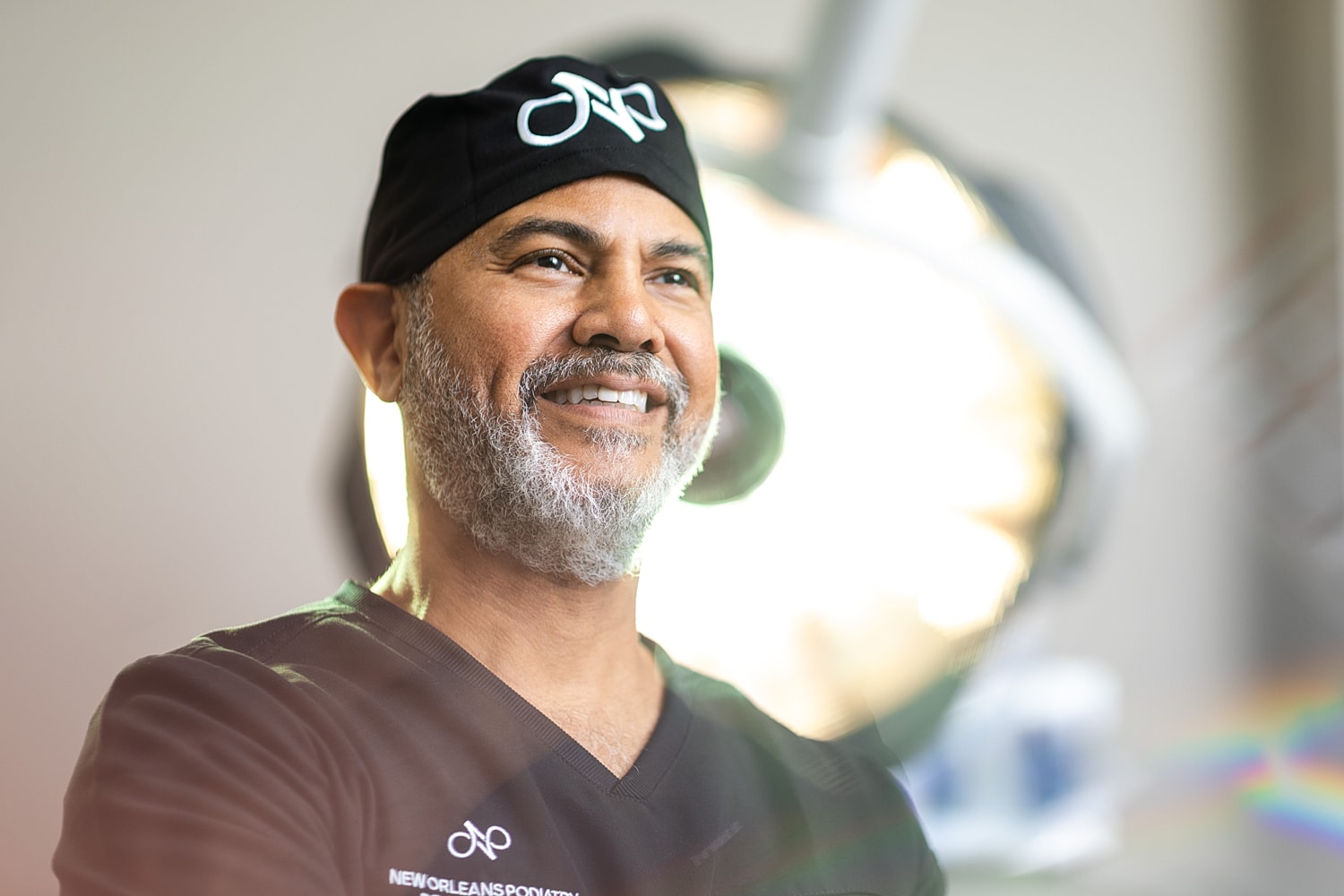
You may be a candidate for surgical correction if you have bunion pain, a visible bump at the base of the big toe, or difficulty wearing shoes comfortably. Candidates often experience swelling, redness, or changes in the way the big toe joint moves.
Bunion surgery is typically recommended when nonsurgical treatments—such as orthotics, bunion pads, or shoe changes—no longer provide adequate relief, or when the deformity is progressing and risks causing nerve damage or secondary conditions like hammertoes.
Surgery may not be appropriate if you have uncontrolled health conditions that increase surgical risk, or if your symptoms are mild and do not significantly affect your daily life. Dr. Lang will review your full medical history and imaging before making any recommendation.
Results That Keep You Moving
With either procedure, patients typically experience resolution of the painful bony bump, restoration of the big toe joint to its normal position, and the ability to wear a wider range of comfortable footwear. The results of bunion surgery can significantly improve comfort, mobility, and quality of life.
The Lapiplasty® technique corrects the bunion at its structural root, which requires a more structured healing process than traditional surgery. In our experience, patients should plan for the following timeline:
•Weeks 0–2: Non-weight bearing (crutches or a walker)
•Weeks 3–4: Partial weight-bearing in a surgical boot
•Week 4 onward: Transition to a tennis shoe and full weight-bearing activity
•Month 3: Most patients return to running and higher-impact activities, though some swelling may persist
Titanium plates used for stabilization can cause prolonged swelling in some patients. These plates are typically removed at 6–12 months, after which recovery is rapid—full weight-bearing from day one and return to regular activities within approximately three weeks.
With MIS, patients are typically able to bear partial weight in a protective surgical shoe the same day as surgery. Most patients return to regular shoes within 14–21 days. Because the incisions are minimal and tissue disruption is reduced, swelling and discomfort are generally milder than with Lapiplasty®, and the overall recovery arc is faster.
Why Patients Choose Dr. Edward Lang at New Orleans Podiatry
If you are searching for a bunion surgeon in New Orleans, experience matters. Dr. Edward Lang has been treating bunions in this city for over 30 years, performing more than 7,700 bone surgeries and more than 21,000 total procedures. He is one of the longest-practicing podiatric surgeons in the region.
As New Orleans' only Lapiplasty® Centurion Center surgeon, Dr. Lang offers the most advanced 3D bunion correction available—alongside a full spectrum of surgical options, including minimally invasive bunion surgery (MIS). Your procedure will be selected based on your anatomy, your goals, and what will give you the best long-term outcome.
What sets New Orleans Podiatry apart is not just surgical skill—it is the continuity of care. Dr. Lang and his team are available throughout your recovery, including direct text access until 9 PM, dedicated follow-up appointments, and insurance coordination. You are not handed off after surgery. You are supported through every step.
Yes. Shoes with a narrow toe box, pointy toes, or high heels can increase pressure on the big toe joint, which may cause or worsen bunions over time.
A physical exam and, if needed, X-rays or magnetic resonance imaging (MRI) can diagnose bunions. The hallmark signs are a visible bump at the joint at the base of the big toe, pain, and the big toe angling toward the second toe.
While you cannot change your inherited foot type, you can prevent bunions from worsening by wearing comfortable shoes with a wide toe box, using orthotic devices, and avoiding shoes that pinch the toes.
Yes. Many people are born with an inherited foot type that predisposes them to bunions or congenital hallux valgus.
Bunion pads and toe spacers can help relieve pressure and make wearing shoes more comfortable, but they will not correct the underlying hallux valgus deformity.
Modern bunion surgery is performed with anesthesia and minimally invasive techniques, so you should not feel pain during the procedure. Discomfort during recovery varies, but our team focuses on reducing pain and guiding you back to normal activity as quickly as possible. Many patients find the recovery no more painful than the chronic discomfort caused by their bunion.

References
American College of Foot and Ankle Surgeons (ACFAS) – FootHealthFacts.org
Mayo Clinic: Bunions – Symptoms and Causes
Lapiplasty® 3D Bunion Correction – Treace Medical Concepts, Inc. https://www.lapiplasty.com
Coughlin MJ, Saltzman CL, Anderson RB. Mann’s Surgery of the Foot and Ankle, 9th ed. Elsevier; 2014.