

Published
10 minute read
Can Focused Shockwave Therapy Help Patients Avoid Plantar Fasciitis Surgery?
What the clinical evidence shows, what the risks and costs look like, and what I see in practice
By Dr. Edward M. Lang, DPM | New Orleans Podiatry
Heel pain that persists for months can change the way people walk, exercise, work, and live. When plantar fasciitis does not respond to conservative treatment, some patients assume surgery is the inevitable next step. It is not always. Focused extracorporeal shockwave therapy (fESWT) offers a nonsurgical option worth discussing before endoscopic plantar fasciotomy (EPF), provided we are honest about both its potential and its limitations.
A patient recently asked me a fair question: is shockwave worth paying for out of pocket, or should I just go straight to surgery? This article is my answer, with the evidence on both sides.
The short answer
For most patients with chronic plantar fasciitis who have not responded to standard conservative care, a course of focused shockwave is a low-risk, moderate-cost step that is reasonable to try before surgery. It does not cut tissue, it has no reported serious complications in the major trials, and if it does not work, surgery is still available. It is not guaranteed to work, and the research is mixed. Both of those things are true, and you deserve to hear both.
First, be certain what is causing the pain
Not all heel pain is plantar fasciitis. Nerve entrapment, stress fracture, fat-pad pathology, and other disorders can produce similar symptoms. The diagnosis begins with a careful examination, and imaging is appropriate when needed to clarify the problem or rule out another cause. Chronic plantar fasciopathy is also not the same clinical picture as a new episode of heel pain: duration, tissue changes, loading tolerance, and previously attempted treatments all shape the plan. No treatment, surgical or not, works well when aimed at the wrong diagnosis.
What does focused shockwave actually do?
Focused shockwave systems deliver acoustic energy to a defined target within the tissue. Unlike surgery, the procedure does not cut or release the plantar fascia. The proposed biological effects include mechanical signaling that may influence pain processing and tissue-repair pathways. These mechanisms remain under study; the strongest clinical claims should rest on measured patient outcomes, not on a promise to “regenerate” tissue.
Focused shockwave is not one identical technology across every machine. Devices generate focused waves electromagnetically, electrohydraulically, or piezoelectrically. Energy settings, treatment head, focal geometry, number of impulses, treatment interval, targeting technique, and the use or avoidance of local anesthesia all matter. These settings cannot necessarily be copied from one machine to another.
Two large randomized trials, two different answers
A 2003 trial by Haake and colleagues, published in the BMJ, randomized 272 patients with chronic plantar fasciitis that had not responded to at least six months of conservative care. At 12 weeks, the study-defined success rate was 34% with shockwave and 30% with placebo, a difference that was not statistically significant. The researchers used a focused Dornier system, delivered 4,000 impulses per session across three sessions two weeks apart, and treated under local anesthesia. This negative study is real, well-conducted evidence and should not be dismissed. [1]
A 2015 randomized, double-blind, multicenter trial by Gollwitzer and colleagues, published in the Journal of Bone and Joint Surgery, enrolled 250 patients whose heel pain had persisted despite at least six months of nonoperative care, including at least two medication-based and two non-medication treatments. At 12 weeks, the median reduction in a composite heel-pain score was 69.2% after active treatment versus 34.5% with sham treatment, and investigators reported success rates between roughly 50% and 65%. Note that 69.2% is the median reduction in a pain score, not the percentage of patients cured. The protocol used an electromagnetic Storz Duolith SD1: three weekly sessions of 2,000 impulses at 0.25 mJ/mm², after a gradual energy ramp-up, without local anesthesia. Most investigators had financial ties to the device manufacturer, which readers should weigh. [2]
These studies do not prove that one device or one setting explains the different results. They do show that shockwave outcomes are sensitive to the patients and protocols studied. Today’s techniques reflect what was learned about targeting, dose, energy ramp-up, and anesthesia, but it would be inaccurate to claim that newer technology has erased the mixed evidence.
What do the major guidelines say?
In plain terms: the experts agree shockwave is safe. They disagree on how well it works. That is exactly why it makes sense as a step before surgery rather than a replacement for honest expectations.
How does shockwave compare with endoscopic plantar fasciotomy?
A 2012 randomized study by Radwan and colleagues compared the two directly in 65 patients whose symptoms had persisted after conservative treatment. At one year, 70.6% of the shockwave group and 77.4% of the endoscopic release group had excellent or good results on the Roles and Maudsley scale; the difference was not statistically significant. This was a small study, not designed to prove the two treatments equivalent, and it did not use PiezoWave. [3]
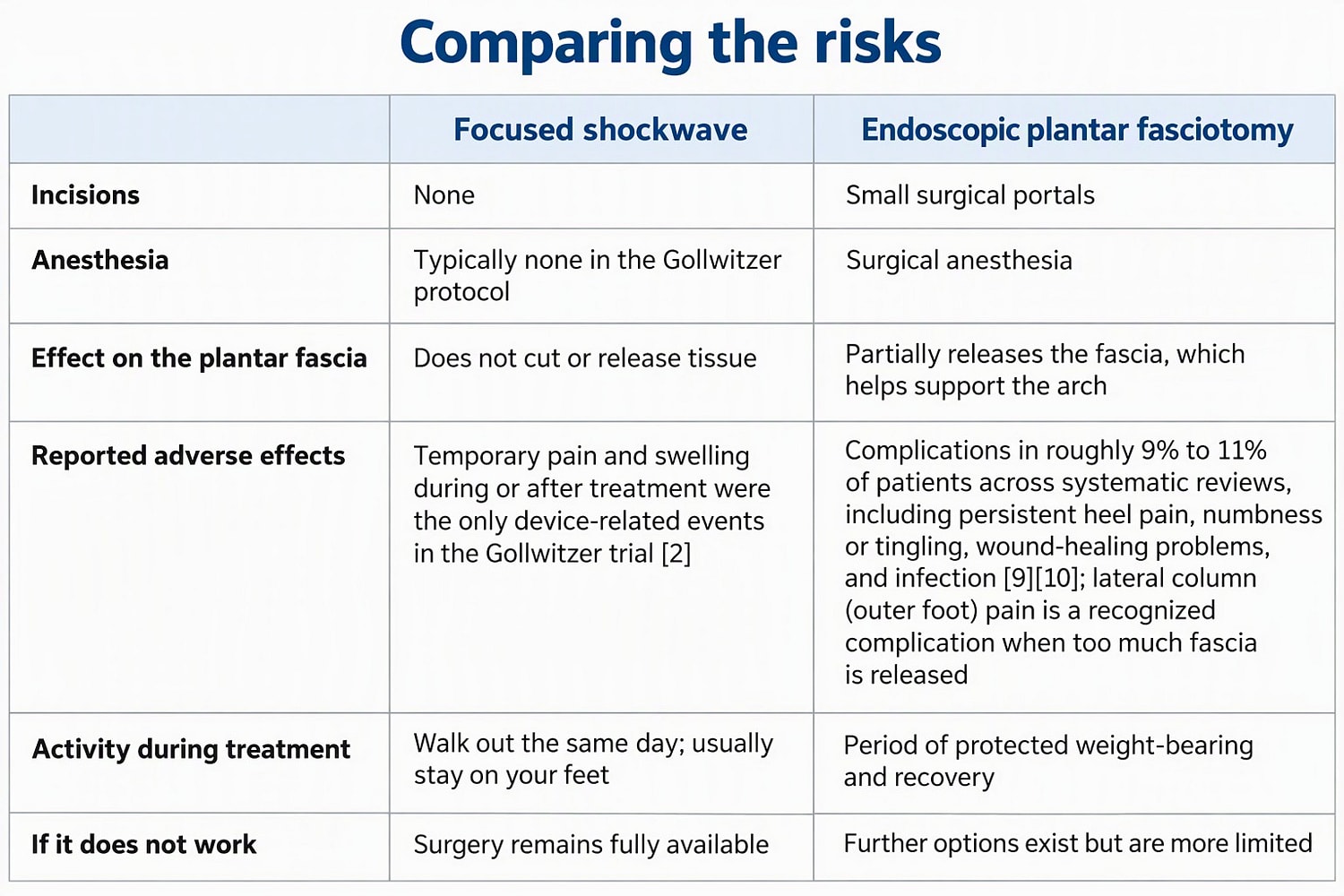
Two other comparisons deserve mention because they lean toward surgery on outcomes. A 2010 prospective study by Othman and Ragab found better results with endoscopic release, but concluded that shockwave’s lack of complications, lack of immobilization, and quicker return to activity make it a reasonable treatment to try before EPF. [7] A 2013 study of athletes by Saxena and colleagues likewise found EPF produced better outcomes, while noting shockwave allows athletes to stay active during treatment. [8] Patients should know that surgery, when it is needed, often works well.
What does it cost?
At New Orleans Podiatry, a package of four focused shockwave sessions is $660. If additional sessions are needed, they are $90 each when completed within three months of your first treatment. That means four sessions plus two extra would total $840.
Most major insurers currently classify shockwave for plantar fasciitis as investigational or not medically necessary (Anthem and Cigna’s 2026 policies are examples), so it is generally paid out of pocket. [11][12] We would rather tell you that up front than have you discover it later.
Surgery is usually billed to insurance, but “covered” is not the same as “free.” Your actual cost depends on your deductible, coinsurance, and separate charges for the surgeon, facility, and anesthesia, plus follow-up visits, any boot or physical therapy, and time away from work or your feet. Before choosing either path, ask your insurer for an estimate of your share of surgery. For many patients, the comparison is closer than it first appears.
Why I use PiezoWave, and what I observe
In my practice I use PiezoWave, a piezoelectric focused shockwave platform made by Richard Wolf GmbH in Germany. Piezoelectric systems generate focused acoustic energy through an array of piezoelectric elements. The largest placebo-controlled trials discussed above used other manufacturers’ systems, so their results should not be read as PiezoWave trial results. I select patients carefully, confirm the diagnosis, and adapt treatment to each patient’s symptoms, examination, and response.
In my clinical experience treating chronic plantar fasciitis with a series of PiezoWave treatments, I see improvement in approximately 70% of patients, and more than half report pain scores of 0 to 1 on a 0 to 10 scale after treatment. I generally see better responses in newer cases than in long-standing ones. These figures are my practice observations, not results from a controlled trial or an independently audited registry, and they are not a guarantee for any individual patient. Newer heel pain also often improves with conservative care alone, so a better response in those cases cannot be credited to the device alone.
Is it worth trying first? My honest view
The decision comes down to a simple comparison of what you risk and what you might gain.
With shockwave, the downside is the cost of the treatment package, a few office visits, and temporary soreness. The upside is a meaningful chance of avoiding an operation, its recovery, and its complication risk. If it does not work, you have lost no surgical options.
With surgery first, you may get relief sooner and, based on some studies, somewhat more reliably. But you accept surgical risk that, for a meaningful share of patients, may never have been necessary.
For a patient whose diagnosis is confirmed and who has given good conservative care a fair trial, I believe trying focused shockwave before surgery is the more conservative and, in most cases, the wiser choice. For some patients, such as those with severe, long-standing symptoms who have exhausted other options, going straight to a surgical discussion may be appropriate. That is a conversation, not a formula.
The next step
For patients in the New Orleans area, an examination is the first step toward determining whether focused shockwave is right for you. Text New Orleans Podiatry at 504-897-3627 or visit www.nolapodiatry.com to request an appointment.
This article is for general education and is not a substitute for an individual medical evaluation.
About the author
Dr. Edward M. Lang, DPM, is the medical director, co-founder, and lead surgeon of New Orleans Podiatry. A board-certified foot surgeon and clinician with 37 years in practice, he has performed more than 21,000 procedures, has had over 250,000 patient encounters, and has eight years of preceptorship experience.
Research and sources